Home
News
History
FAQs:
Sales
Applications
Technical
Customizing
Transport
References
Gallery
Downloads
Release Notes
Tips & Tricks
Ordering
Contact us
Privacy policy

News!
- May 15, 2023
- Acoustimetrics, the maker of the Acousonde, has reorganized and is now managed entirely and independently by its original design personnel. Please see the announcement on the Acoustimetrics web site.
- April 24, 2014
- Congratulations to Denise Risch and her coauthors for their discovery of the Antarctic minke whale as the source of the "bio-duck" sound, solving a half-century-old Southern Ocean mystery! The findings were published this week in Biology Letters.
I am thrilled to say that the Acousonde 3B acquired the data that made the discovery possible. Some photos of the February 2013 field work may be found towards the end of the Acousonde gallery; here is one example.
The discovery has been widely reported in the popular media. This 50-second video published by Slate includes an example of the "bio-duck" sound.
I'm deeply honored to have played a part in this work and wish the authors the very best in their future research!
- June 2013
-
Firmware 2.2 for the Acousonde 3A and 3B supports high-time-resolution
accelerometry, raising the maximum accelerometer sample rate from 20 to 800 Hz!
The new firmware also raises the maximum compass sample rate from 20 to 40 Hz,
the hardware limit.
For Acousonde 3B models, the firmware enables sampling of the
light-level channel built into all 3B units.
See detailed release notes here.
The new firmware and updated commanding app provide the following sampling programs on the Acousonde 3B. Due to the Acousonde 3A's lack of a light sensor, 3A models will not sample light level but will instead sample temperature more often for rates faster than 1 Hz.
- 5-s period all aux channels (compass, accel, depth, temperature, light)
- 1 Hz all aux channels
- 5 Hz all aux channels, except depth/temp/light sampled at 1 Hz
- 10 Hz all aux channels, except depth/temp/light sampled at 1 Hz
- 10 Hz all aux channels, except temp/light sampled at 5 Hz
- 100 Hz accelerometer; 10 Hz compass/depth; 5 Hz temp/light
- 400 Hz accelerometer; 20 Hz compass; 10 Hz depth; 5 Hz temp/light
- 800 Hz accelerometer; 40 Hz compass; 10 Hz depth; 5 Hz temp/light
Note that, although accelerometer channels are sampled simultaneously, compass channels are not. See this FAQ entry detailing sampling behavior for auxiliary channels. Please also see this clarification regarding the capabilities of the 3B light sensor.
Customers may update firmware themselves by following these instructions; alternately, US customers are welcome to return units directly to Acoustimetrics for firmware update at no charge. International customers who wish to return units for firmware update should contact Cetacean Research Technology, the Acousonde distributor. Contact information may be found here..
- September 5, 2012
-
The Acousonde 3B design has demonstrated
an attachment life of ∼2 days,
carried over a distance of ∼120 km (∼65 nautical miles) by
a free-ranging male tusk-bearing narwhal
in East Greenland. The test, conducted by Mads Peter
Heide-Jørgensen with the Greenland
Institute of Natural Resources, relied on the Acousonde 3B's
standard configuration of four 3-cm silicone suction cups secured by
hand to a temporarily captive wild narwhal. An added
satellite transmitter
and extra flotation allowed the tag to be located and retrieved after
being carried such a distance.
This attachment life quadruples the Acousonde 3B's previous record, a 12-hour attachment to a pantropical spotted dolphin in May 2011; see the 2011 Society for Marine Mammalogy poster.
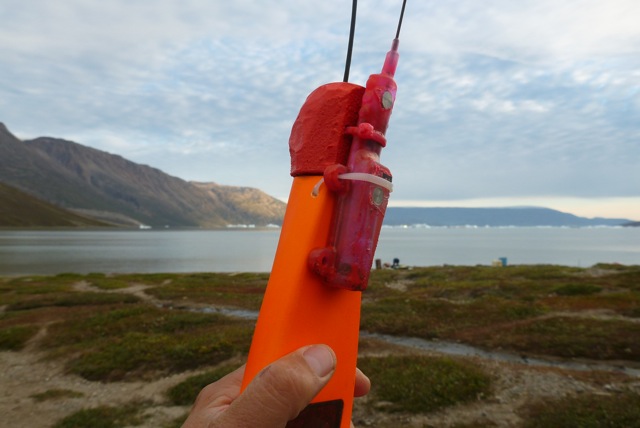
User-added flotation and satellite transmitter on the trailing end of an Acousonde 3B. Photo by Mads Peter Heide-Jørgensen, used with permission.
Acousonde 3B attached by hand to a temporarily captive male tusk-bearing narwhal in East Greenland using the 3B's standard suction-cup configuration. Photo by Mads Peter Heide-Jørgensen, used with permission. - January 27, 2012
-
An Acousonde 3A has successfully sustained a 464-kHz acoustic sample rate in two tests powered by
its standard lithium A-cell. In the first test
at room temperature, recording lasted 34 hours, filling 114 GB of onboard storage before
the battery gave out.
In the second test at an average of 7.5°C, recording lasted 38 hours, filling all 128 GB
available.
Until now high-frequency-enabled Acousonde units could not reach their expected maximum sample rate of 232 kHz due to firmware limitations. Firmware Version 2.1 makes use of special-purpose hardware built into every Acousonde to reduce power consumption by as much as 50% and to reach — and exceed by double! — the originally-expected maximum sample rate.
Even Acousonde units without the high-frequency option can benefit from Version 2.1's substantial reduction in power consumption. New units (August 2011 or after) with the high-frequency option can sustain the 464-kHz sample rate, while older units with the high-frequency option will sustain 232-kHz sampling.
A beta-test release of the new firmware is available to interested Acousonde users.
- May 18, 2011
- The first deployment of an Acousonde™ 3B with an animal
took place 11 May 2011.
Cascadia Research, in collaboration with the
NOAA Pacific Islands
Fisheries Science Center and
Acoustimetrics, placed the tag on a pantropical
spotted dolphin off the coast of the Big Island of Hawai`i.
The Office of Naval Research
provided support for the effort.
From the beginning, development of the Acousonde 3B centered on potential applications with small odontocetes, emphasizing small size, hydrodynamic overall shape including float, and low profile. Until this deployment, however, these design ideas had remained untested.
We are happy to report that, even on this relatively small and fast-moving animal, the tag remained attached for 12 hours, 18 minutes. It gathered acoustic data using its high-frequency hydrophone at 116 kHz sample rate until the primary storage card filled (a total of 8 hours, 22 minutes on the animal in addition to 50 minutes pre-deployment). Auxiliary data gathered consisted of dive depth and tag temperature at 10 Hz, and 3D tilt and 3D compass at 20 Hz, sampled continuously until the tag was manually stopped after its recovery two days later.
Going forward, we plan to improve the suction-cup system to extend attachment time, while implementing software support for greater acoustic recording capacity (please see the release notes for the current software status).
The following three photographs, reposted here from Cascadia's web log of their May 2011 Hawai`i Island field work, were taken under NMFS Scientific Research Permit No. 731-1774.

Attempting to deploy the Acousonde 3B on a pantropical spotted dolphin. Photo by Robin Baird, used with permission.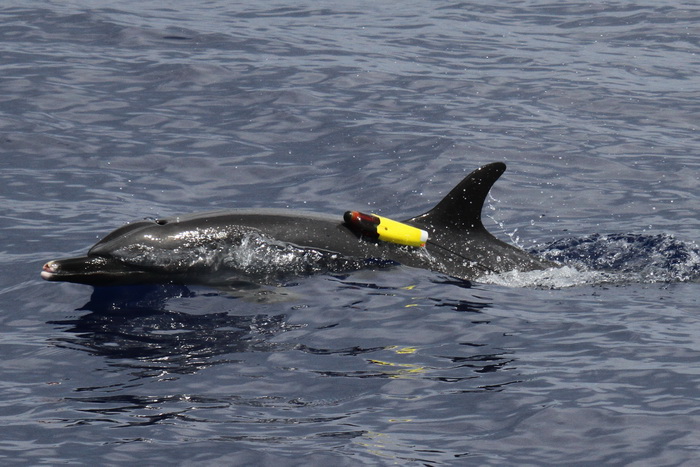
Acousonde 3B attached to a pantropical spotted dolphin with suction cups. Photo by Robin Baird, used with permission.
An Acousonde 3A, equipped with a float designed and built by Cetacean Research Technology, was also deployed during the field work. This unit was attached to a short-finned pilot whale with suction cups on 6 May. Photo by Robin Baird, used with permission. - January 18, 2011
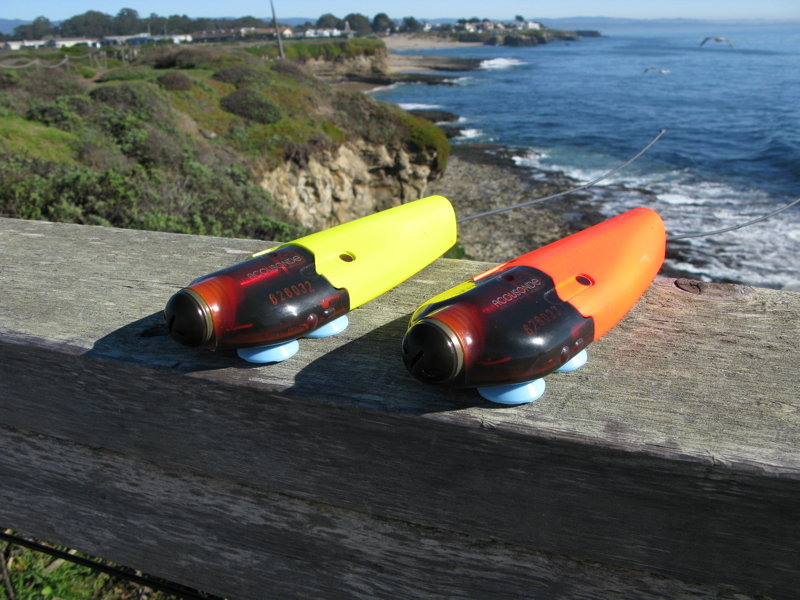
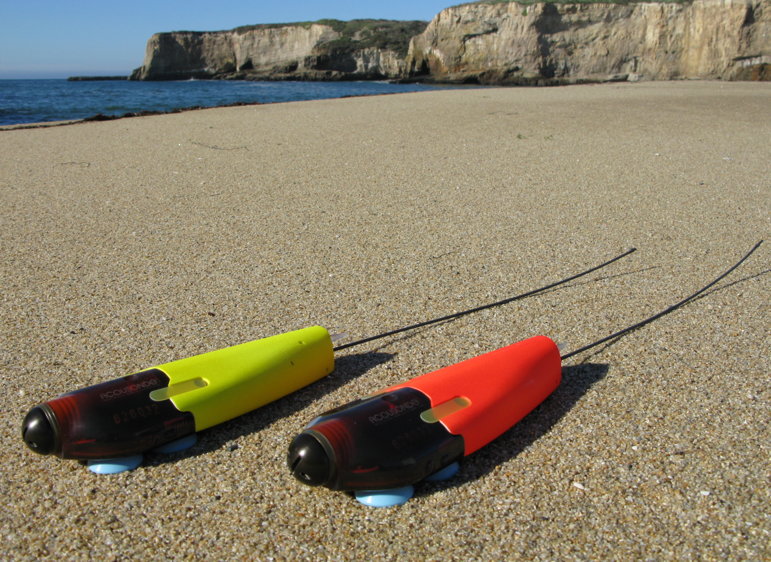
- It is a pleasure to announce that the Acousonde™ 3B marine acoustic recording tag is now shipping!
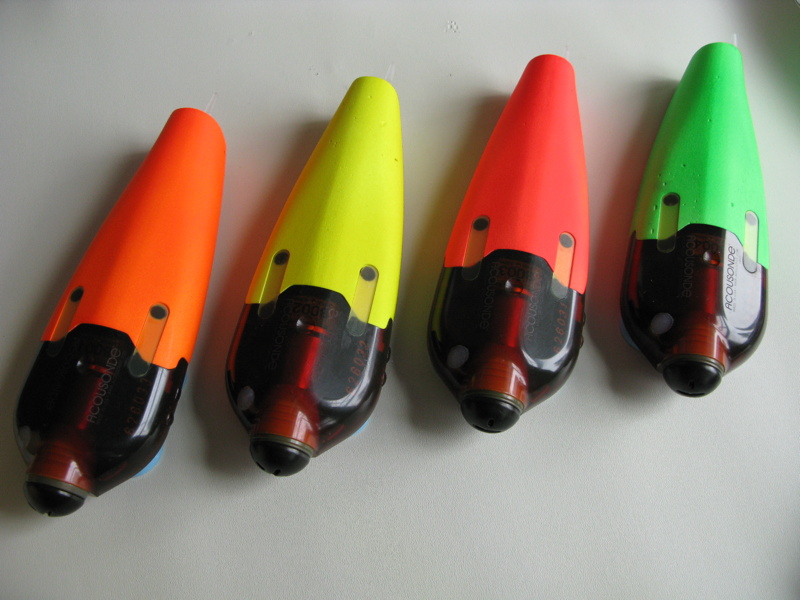
The Acousonde 3B is a complete mechanical redesign of its cylindrical sibling, the Acousonde 3A, specifically for application as a cetacean tag. The 3B's electronics, suction cups, and flotation form a single, low-profile, hydrodynamic package that should remain attached for longer periods and with lower flow noise than the 3A and its predecessor the Bioacoustic Probe.
The 3B has yet to see its first subject, so as the community gains experience with this tool we will surely have ideas on refining the design. We particularly welcome thoughts on how to improve the suction cups; these are field-replaceable and alternative designs may easily be tested. There is at present no explicit release mechanism, but space has been reserved in the mechanical design and we hope to implement release technology in the future.
Please see the one-page brochure and a mechanical diagram for permitting information. Thank you all so much for your past support of the Bioacoustic Probe and the Acousonde 3A. Thanks especially to the United States Office of Naval Research that made this whole project possible.
- August 15, 2010
- Development of the Acousonde miniature marine acoustic recorder reached two milestones this month.
First, all planned functionality has finally been incorporated in the software operating system. Of particular interest to the animal-tag community is the recording of "auxiliary" channels: pressure, temperature, 3D acceleration, and 3D compass. Others will welcome the ability to record on a timed duty cycle to extend deployment life. The work isn't done; performance improvements remain, for example raising the current maximum 116-kHz acoustic sample rate to 232 kHz (high-frequency channel only) and the maximum auxiliary rate from 20 Hz to 40 Hz. But all originally-intended functionality is now in place.
Second, we have finished designing and begun fabricating the first units of the dedicated animal-tag "Acousonde 3B". The 3B is a complete mechanical redesign of the Acousonde to integrate attachment and flotation with the tag, rather than requiring the user to add them after procurement. By designing the tag, attachment and flotation together we have made the overall package much smaller and more hydrodynamic than in the past.
- January 16, 2009
- The Acousonde™ 3A is formally announced.